
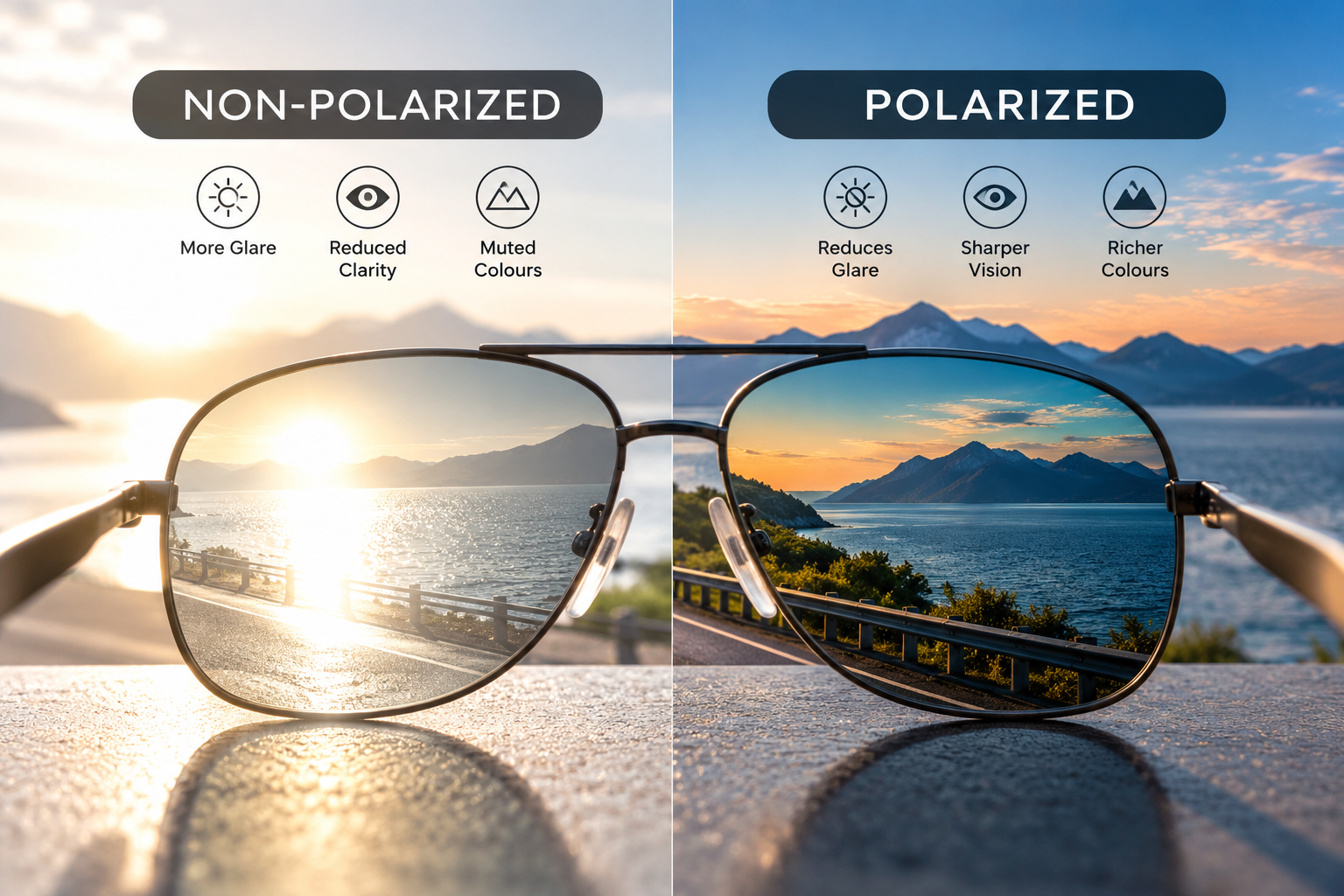
Imagine driving down a sun-drenched highway, the pavement ahead shimmering with a blinding sheet of white light bouncing off the hood of the car in front of you. Or picture standing by a shimmering lake on a brilliant summer afternoon, completely unable to see beneath the surface because the water’s reflection acts like an opaque mirror.
We’ve all experienced this visual nuisance. But have you ever wondered why some sunglasses effortlessly melt that blinding glare away while others just dim the brightness?
The secret lies in the fascinating physics of light filtration. Whether you are curating your everyday look or prepping for your next outdoor adventure, choosing the right eyewear makes all the difference. Let’s dive deep into the ultimate breakdown of Polarized vs Non-Polarized Sunglasses to help you see the world clearer, sharper, and safer.
Understanding Light and Glare: The Invisible Force
To understand how sunglasses protect our vision, we first need to look at how light travels. Sunlight radiates in all directions as electromagnetic waves. When those rays strike a flat, horizontal surface—such as water, asphalt, snow, or a car windshield—they bounce off and scatter horizontally.
This concentrated horizontal wave creates glare: an intense, uncomfortable beam of light that overpowers your vision, reduces contrast, and can cause severe eye strain or headaches.
Standard sunglasses act as a basic dimmer switch. They simply reduce the overall intensity of all light entering your eyes equally. But they do nothing to block that harsh, blinding horizontal glare. That is where specialized optical technology steps in.
What is Polarized Lens?
So, what is a polarized lens? Think of a polarized lens as a microscopic Venetian blind for your eyes.
Manufacturers embed a special chemical filter inside the lens that is laminated with vertical stripes. Because light waves vibrate in specific directions, this vertical grid allows vertical light waves (which give you useful data like brightness and color) to pass through freely. However, it completely blocks horizontal light waves—the exact ones responsible for blinding glare.
The Benefits of Polarization:
-
Crystal Clear Vision: Eliminates harsh reflections from water, snow, glass, and roads.
-
Enhanced Contrast: Colors appear richer, deeper, and more vibrant because they aren’t washed out by white glare.
-
Reduced Eye Fatigue: Prevents squinting and reduces the risk of headaches during long hours spent outdoors.
Exploring the Classics: Polaroid Sunglasses
When people talk about the pioneers of this technology, the name Polaroid sunglasses almost always comes up. Originally popularized by Edwin H. Land—the founder of the Polaroid Corporation—this iconic brand revolutionized optics by introducing commercially viable synthetic light polarizers.
While many eyewear brands today manufacture polarized options, the term “Polaroid” remains synonymous with high-grade optical clarity and reliable glare reduction. Choosing a trusted, quality pair ensures that the polarizing filter is correctly aligned to block unwanted light effectively without causing visual distortion.
Polarized vs Non-Polarized Sunglasses: Head-to-Head Comparison
While polarized lenses sound superior at first glance, both types have distinct purposes, strengths, and ideal use cases. Let’s break down how they stack up against each other:
| Feature | Polarized Sunglasses | Non-Polarized Sunglasses |
| Primary Function | Blocks blinding glare and reduces surface reflections | Reduces overall light intensity (dims brightness) |
| Visual Clarity | Superior contrast and color depth around reflective surfaces | Standard view with natural brightness reduction |
| Best For | Driving, fishing, boating, skiing, beach days, and outdoor sports | Casual daily wear, cloudy days, fashion |
| Digital Screen Interaction | Can darken or distort LCD/OLED screens (phones, car dashboards, ATMs) | Unaffected; crystal-clear view of all digital displays |
| Price Point | Generally higher due to advanced chemical filtering technology | Typically more budget-friendly |
When to Choose Non-Polarized Lenses
Despite the massive perks of polarization, there are specific scenarios where non-Polarized sunglasses are actually the better choice:
-
Reading Digital Dashboards and Screens: Pilots, sailors, and drivers often rely on digital instrumentation. Polarized lenses can make LCD screens, smartphones, and car GPS displays look completely black or illegible at certain angles.
-
Skiing and Winter Sports: While snow creates terrible glare, skiers sometimes prefer non-polarized lenses to help them spot icy patches on slopes, as polarization can inadvertently blend shiny ice patches into the surrounding snow.
-
Low-Light Conditions: For overcast days, early mornings, or deep forests, non-polarized lenses provide sufficient tint without unnecessarily darkening your field of vision.
Making the Right Choice for Your Lifestyle
Ultimately, the battle of Polarized vs Non-Polarized Sunglasses comes down to how and where you spend your time.
If you are an avid angler, a frequent driver battling highway glare, or someone who loves spending sunny afternoons by the water, investing in a quality pair of polarized sunglasses is a game-changer for your eye comfort and safety. On the other hand, if you need a versatile, stylish pair for everyday urban errands, casual walks, and frequent phone checking, a classic non-polarized pair will serve you exceptionally well.
Which type of sunglasses do you typically reach for when heading out the door?